Travel and Expense
New Research Reveals Growing Paradox at the Center of Business Travel
Findings from the eighth annual SAP Concur Global Business Travel Survey suggest employees increasingly experience business travel through two competing realities.
While business travellers overwhelmingly say work trips improve wellbeing and strengthen human connection, many also say that travel now feels more stressful and unpredictable due to safety concerns, disruptions, and growing pressures in their role.
“Organisations continue to find substantial value in business travel, but what employees expect from the experience is changing,” said Charlie Sultan, President of Concur Travel at SAP Concur. “Business travellers appreciate the connection and collaboration that come from meeting in person. They also expect travel to feel smoother, safer, and easier to navigate. This is creating new challenges and opportunities for companies as they consider the future of their corporate travel programmes.”
Here are some of the key findings from the research.
Business travel still delivers value, but expectations are evolving
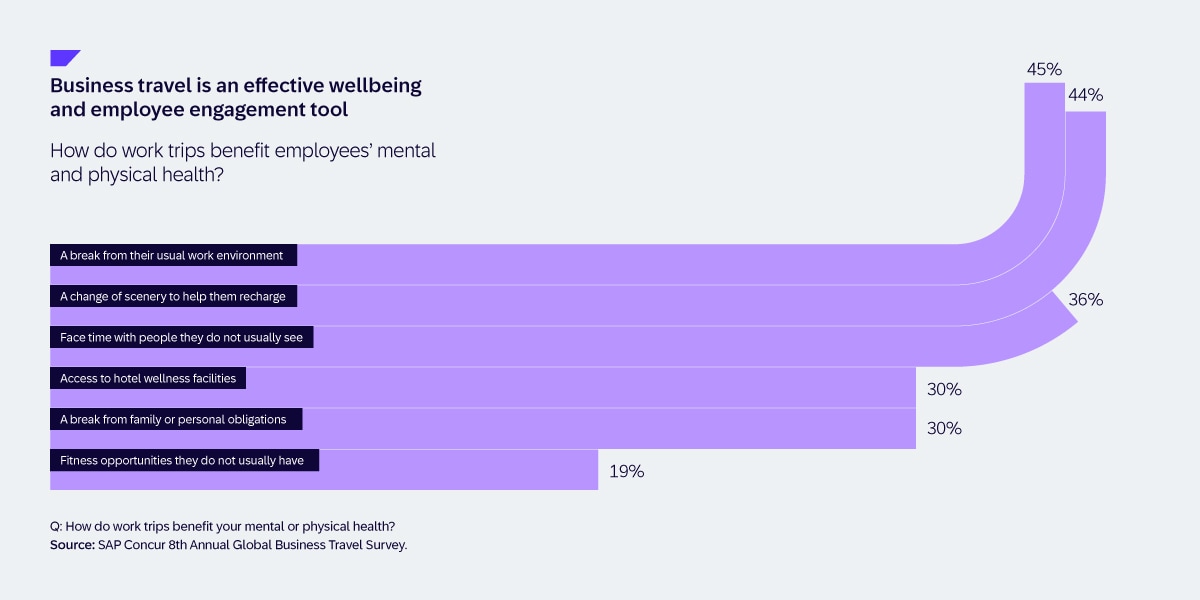
Despite ongoing disruptions in global travel, employees continue to say business travel delivers personal and professional value. Ninety-three per cent of business travellers say work travel benefits their mental or physical well-being. Among the top benefits cited:
- 45% say business travel gives them a break from their office or home work environment.
- 44% say a change of scenery helps them mentally recharge.
- 36% say it gives them an opportunity for face time with people they don’t typically get to
- see.
- 30% say it gives them a brief break from family or personal obligations.
- 30% say it allows them to take advantage of hotel wellness amenities.
- 19% say it provides fitness-related opportunities that they don’t usually have.
Some benefits stand out more among business travellers who are parents compared to non-parents. For example, 33% of parents said that business travel provides a break from family or personal obligations, compared to 26% of non-parents. Parents were also more likely to cite access to hotel wellness amenities (33% vs 25%) and fitness opportunities they do not usually have (22% vs 14%) as benefits of business travel.
These findings suggest employees increasingly view business travel as more than a transactional business function. In an era shaped by burnout and digital fatigue, many workers see travel as an opportunity to reconnect with colleagues, customers, and themselves.
Finance leaders continue to recognise the strategic value of business travel. Nearly all CFOs surveyed (97%) say business travel is important to their organisation’s overall growth strategy, and 82% expect their company’s travel budget to increase this year. But growing investment also brings greater scrutiny. Nearly nine in 10 CFOs (89%) agree that their travel managers need to better justify how business travel helps their organisation meet business goals.
However, travel managers say they are being asked to prove ROI without enough organisational support. Eighty-four per cent agree that it’s impossible for them to fully meet their organisation’s business goals without more support from finance leadership, including better data and insights to demonstrate ROI (44%), training on the most effective ways to use AI (43%), greater buy-in on policy changes or new initiatives (42%), and updated technology solutions (40%).
Modern business travel is becoming more stressful and unpredictable
Even as employees value business travel, many are increasingly uneasy about the realities of modern travel. Sixty-seven per cent of business travellers say they are hesitant to travel for business this year, and their concerns reflect broader instability across the global travel environment:
- 31% cite safety concerns around travelling to areas affected by geopolitical conflicts or
- tension.
- 28% cite the likelihood of travel disruptions, such as flight delays or cancellations.
- 16% cite concerns over visas, immigration status, and digital IDs.
Additionally, nearly one in four (24%) say overcrowding or overtourism has negatively impacted a business trip. In response, 87% of business travellers say they try to avoid staying in the most tourist-heavy areas during work trips. Among the top frustrations:
- 43% point to higher costs in crowded destinations.
- 38% say it’s tougher to get around in over-touristed areas.
- 33% report difficulty in finding preferred travel options due to overbooking or limited supply.
- 27% cite discomfort being surrounded by so many people.
- 26% note greater safety risks or concerns about hostility toward tourists.
The findings suggest that employees increasingly value business travel, but many elements of it are frustrating.
Employees expect more support from employers while travelling
This year’s survey also reveals changing expectations around employer responsibility and business traveller support. More than a quarter (27%) of business travellers say they hold their employer most accountable to protect their safety while travelling for work—a notable difference from 18% when a similar question was asked in 2020.
Thirty-seven per cent of business travellers hold themselves most accountable, a belief held more by older generations than younger ones (baby boomers: 47%, Gen X: 43%, millennials: 35%, Gen Z: 33%). Only 6% hold the government most accountable.
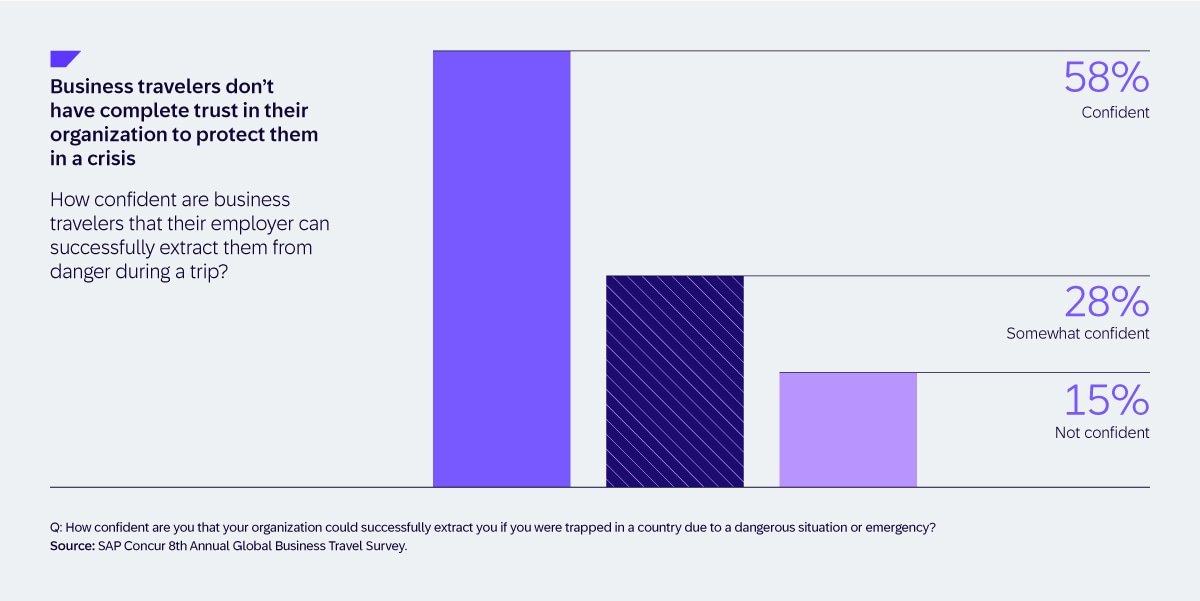
At the same time, confidence in employer preparedness is mixed. Only 58% of business travellers say they are mostly or completely confident their organisation could successfully extract them if they were trapped in a country due to a dangerous situation or emergency.
Organisations have a legal obligation to take reasonable steps to protect employees during work-related travel. However, 86% of travel managers say they are concerned their organisation is not doing enough to protect employee safety while travelling. Just 38% of CFOs say their organisation is completely responsible for ensuring the safety of employees while travelling for work, with most (57%) saying the company is somewhat responsible, but this falls primarily on employees.
It’s also important to note that, according to travel managers, the greatest threat to their company’s business travel this year isn’t geopolitical conflicts (43%), last-minute delays (39%), or travel disruptions associated with severe weather (39%)—it’s the risk of sensitive information being hacked when travelling abroad (44%).
On the tech side, employees are open to sharing personal data if it improves safety and support during travel. Seventy-nine per cent of business travellers say they are at least somewhat comfortable with employers tracking their location while travelling for work to better protect their safety. But trust remains a critical factor, as nearly one-third (29%) of business travellers globally say real-time monitoring of location and expenses on work trips would cause them to lose trust in the decisions of their organisation’s leaders.
The findings highlight a growing balancing act for organisations: employees increasingly want reassurance and support from employers during travel, while also expecting transparency around how business traveller data is used.
The future of business travel may depend on trust
The 2026 SAP Concur Global Business Travel Survey shows that business travel continues to deliver significant value for growth, collaboration, and employee experience.
But the findings also highlight growing gaps between what organisations expect from travel programmes and how employees experience business travel. Those gaps increasingly affect business traveller wellbeing, duty of care, and confidence in leadership.
Organisations that can close those gaps—through clearer communication, better governance, stronger business traveller support, and tools employees want to use—will be better positioned to build travel programs that employees trust and that leadership teams can confidently support.

Now Available: 8th Annual SAP Concur Global Business Travel Survey
For more findings from this year’s Global Business Travel Survey, download the report here.
Get the 2026 reportThe SAP Concur Global Business Traveler Survey was conducted by Wakefield Research between April 1-20, 2026, among 3,300 business travelers in 21 markets: ANZ (Australia, New Zealand), Benelux (Belgium, Netherlands, Luxembourg), Brazil, Canada, Denmark, Finland, France, Germany, India, Italy, Japan, Mexico, Norway, Portugal, Saudi Arabia, Singapore, Spain, Sweden, Switzerland, UK, and U.S.
The SAP Concur Global Travel Manager Survey was conducted by Wakefield Research between April 1-20, 2026, among 800 travel managers, defined as those who direct or administer travel programs for businesses, across eight markets: ANZ (Australia and New Zealand), Canada, Germany, India, Italy, Japan, UK, and U.S.
The SAP Concur Global CFO Survey was conducted by Wakefield Research between April 1-20, 2026, among 700 CFOs across seven markets: ANZ (Australia and New Zealand), Canada, Germany, Italy, Japan, UK, and U.S.